
Air Duct Cleaning Cost Guide: What Downtown San Diego Homeowners Pay in 2026
Air duct cleaning in Downtown San Diego typically costs between $450 and $900 for a full system in 2026, depending on the size of the home, number of registers, and how much contamination has built up. That’s a wide range, and it exists for a reason. A $149 whole-home duct cleaning quote covers one technician with a shop-vac-grade machine; the $650 quote covers mechanical agitation, negative-pressure containment, and documentation. They are not the same service.
If you’re trying to sort through quotes and want a straight answer for your building, call (866) 282-6412. We answer 24/7. Fast dispatch from 7am to 7pm, Sunday through Friday.
The Real Reason Duct Cleaning Quotes Vary So Much
Most cost guides treat duct cleaning like a commodity. It isn’t. The price difference you’re seeing between a $149 quote and a $695 quote in Downtown San Diego isn’t greed on one side and generosity on the other. It’s two different scopes of work being described with the same three words.
Legitimate cost drivers include:
- Linear footage of ductwork – a 900-square-foot condo has less duct than a 3,200-square-foot loft conversion in the East Village. More duct means more time.
- Number of supply and return registers – each register needs to be accessed, sealed, and run through the agitation process. A two-bedroom unit might have eight registers. A penthouse could have twenty.
- Accessibility – attic ducts in older buildings around Cortez Hill are often tighter to work in than a dedicated mechanical closet in a newer tower. Crawlspace access slows everything down.
- Contamination level – normal dust accumulation cleans faster than construction debris or years of pet dander packed into the return side.
- Equipment class – a portable unit with a brush on the end of a drill does less than a truck-mounted or high-output negative-air system. Both can be called “duct cleaning.”
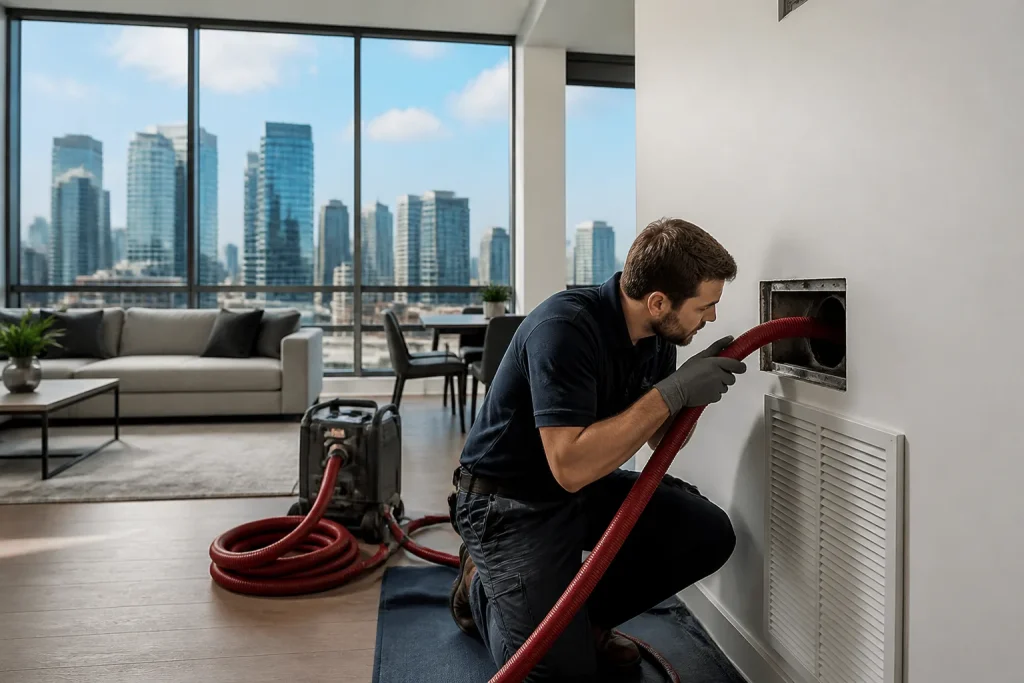
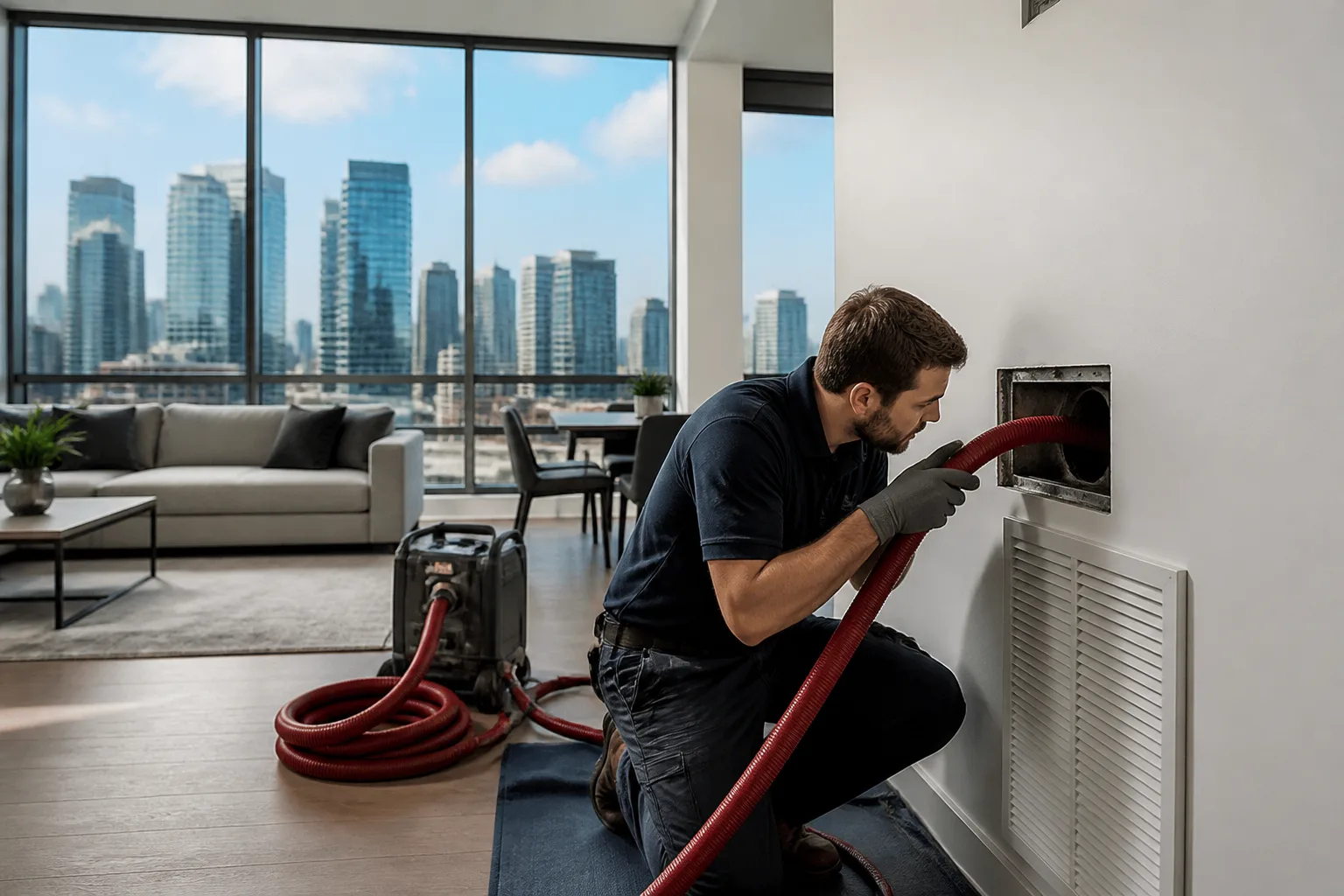
We run Rotobrush rotary brush systems and Nikro HVAC cleaning equipment, the same professional-grade tools used in commercial and restoration work. The equipment matters because it determines whether the debris actually leaves the system or just gets knocked loose and redistributed through the living space.
Why Downtown San Diego Buildings Price Differently Than the Suburbs
Downtown San Diego isn’t one housing type. It’s a stack of different duct configurations squeezed into a few square miles, and that affects what you’ll pay more than your ZIP code alone.
High-rise condos in the Marina District and Columbia typically run ductwork vertically through chases and fire-rated walls. Access points are limited, runs are long, and the air handler is often tucked into a closet with minimal clearance. That’s a different job than a single-story Craftsman in Golden Hill, where ducts run through a crawlspace and every register is reachable from below.
Older buildings, particularly converted warehouses and pre-1970s construction, often have duct systems that were modified over decades. We routinely see returns that were added after the fact, transitions that don’t seal properly, and flex duct that has deteriorated. If you’re in a building with original ductwork from the 1950s or 1960s, the cleaning may reveal breaches that need repair before the system holds negative pressure properly.
None of this is a problem, but it does mean a blanket “per-vent” price from a mailer doesn’t reflect the actual conditions in a Downtown San Diego building. You need someone looking at your specific system to give you a number that means anything.
What a Fair Quote Looks Like: Line by Line
A legitimate duct cleaning proposal should break down what you’re actually paying for. If a quote is a single number with no scope description, that’s a flag. If it’s priced per vent with a low teaser number, that’s a bigger flag.
Here’s what we include when we estimate a system for a Downtown San Diego home:
- System inspection – before any cleaning starts, we look at the duct layout, check access points, and identify whether there’s moisture, mold, or structural damage. This takes time and should be reflected in the quote.
- Mechanical agitation – brushes or air whips that physically dislodge debris from duct walls. Without this step, a vacuum alone can’t pull packed dust off the interior surfaces.
- Negative-pressure containment – a vacuum system that keeps the duct under negative pressure while agitation happens, so debris gets pulled into the collection unit rather than blown into your unit.
- Register and grille cleaning – every supply and return cover should be removed, cleaned, and reinstalled. This is standard work, but it’s often skipped on cheap jobs.
- Post-cleaning verification – before-and-after photos of the ducts themselves. If a company can’t show you what the inside of your ducts looked like before and after, ask how they’ll prove the work was done.
Some jobs legitimately cost more. If dryer vent cleaning gets added, that’s a fire-safety service on its own and deserves its own line item. If we find confirmed mold presence, a sanitizer application is worth the added cost. If cleaning reveals breaches in the ductwork, sealing or repair is additional work with additional time and materials.
What you should never pay for: a per-vent price that escalates once the technician arrives, a service that doesn’t mention negative pressure at all, and any quote that doesn’t include a verification method. If they won’t show you the inside of your ducts after the job, walk away.
Three Questions to Ask Any Duct Cleaning Company Before You Hire Them
You don’t need to become a duct cleaning expert to compare quotes intelligently. But you should ask three questions, because the answers will tell you more than the dollar figure ever will.
1. What equipment do you use?
This matters. A shop vac with a long hose is not a duct cleaning system. It can’t maintain negative pressure across the full duct run, and it can’t agitate debris out of the duct walls. Professional-grade systems like Rotobrush and Nikro are designed for this specific job. Ask the company to name their equipment. If they hesitate or say “commercial-grade machine” without specifics, that’s your answer.
2. What’s your process from start to finish?
They should be able to walk you through it in 30 seconds: inspection, sealing the system, negative pressure, agitation, verification. If the process is “we vacuum the vents,” that’s not duct cleaning. That’s register vacuuming, which you can do with the attachments that came with your household vacuum.
3. How do you prove the work was done?
The honest answer is before-and-after photos of the interior of the ducts taken with a borescope or inspection camera. If a company doesn’t offer this, you’re taking their word on faith. In an industry with a documented bait-and-switch problem, that’s not enough.
When to call a pro: if you can’t access the full duct system, if you see visible mold growth around registers, if you’ve had a renovation that generated drywall dust, or if anyone in the household has unexplained respiratory irritation that worsens at home. These aren’t DIY situations. Duct cleaning involves equipment that costs thousands of dollars, and doing it wrong can worsen the air quality problem you’re trying to solve.
How Downtown San Diego’s Dust and Weather Patterns Affect Your Ducts
Downtown San Diego’s climate is dry and mild for most of the year, but the urban environment generates its own particulate load. Construction dust from ongoing development, vehicle exhaust from the 5 and 163 corridors, and fine particles that make their way through window seals all end up in the duct system. Buildings near active construction sites around East Village and the Ballpark District will accumulate debris faster than units in quieter residential pockets.
The mild winters also mean Downtown San Diego HVAC systems don’t run as consistently as systems in colder climates. Systems that cycle less often give dust more time to settle in the ductwork, and when the system does kick on, that accumulated debris gets pushed through the living space. It’s a different pattern than a Midwest home that runs the furnace daily for five months straight.
What this means practically: a Downtown San Diego condo that hasn’t had ducts cleaned in five years may look worse inside the ductwork than a suburban house with the same timeline, because the system never gets the sustained airflow that would otherwise keep lighter debris moving toward the filter.
What Legitimately Adds Cost (And Is Worth Paying For)
Some add-ons are upsells. Others are real work with real value. Here’s the difference as we see it.
Dryer vent cleaning is worth including. Your dryer vent is a fire risk waiting to happen, and we treat dryer vent cleaning as a dedicated fire-prevention service, not an afterthought. Lint accumulation in a vent restricts airflow, drives up drying time, and creates a fuel load that can ignite. If you’re already having your ducts cleaned, have the dryer vent done at the same time.
Sanitizer application after confirmed mold presence is worth paying for. Not every duct system needs sanitizer. But if inspection reveals active mold growth, cleaning alone removes the visible surface layer while leaving spores behind. A sanitizer application is the difference between remediation and a temporary fix. We stock and work with Abatement Technologies equipment for elevated contamination scenarios, which means we can handle mold and construction-dust situations that go beyond standard residential cleaning.
Duct sealing after breaches are found is worth paying for. If cleaning reveals gaps, disconnected sections, or damaged flex duct, sealing those breaches matters. A leaky return pulls air from wherever the breach is, which could be a dusty wall cavity or a crawlspace. Cleaning is the first step. Sealing is what keeps the system functioning as designed afterward. We handle air duct cleaning, dryer vent work, and air duct repair as a single specialist company, so you don’t need a second contractor for the repair piece.
Related services in Downtown San Diego: if you manage a rental property or own a condo with shared duct infrastructure, the scope of work may differ from a single-family home. We explain what applies to your building before any work starts.
The Bottom Line
Duct cleaning in Downtown San Diego costs anywhere from $450 to $900 for most residential systems in 2026, and the price is driven by the size of your system, the number of registers, how accessible the ductwork is, and how much contamination has accumulated. Low-ball quotes usually mean low-effort work: no negative pressure, no mechanical agitation, no verification photos. Higher quotes should mean professional-grade equipment, a documented process, and proof the debris actually left the building.
Here’s what we tell every homeowner: get the scope of work in writing before you compare dollars. Compare equipment names, process descriptions, and documentation methods. If a quote can’t tell you exactly what’s included, it isn’t a quote; it’s a starting point for a larger invoice.
If you’re in Downtown San Diego and want an honest assessment of your system, Blackstone Air Duct Cleaning offers free estimates. We’ll inspect your ducts, explain what you’re looking at, and give you a written scope of work with the price attached. Call (866) 282-6412. We answer 24/7. Fast dispatch from 7am to 7pm, Sunday through Friday.
Frequently Asked Questions
Most Downtown San Diego homes pay between $450 and $900 for full-system air duct cleaning in 2026. The range reflects differences in duct size, register count, accessibility, and contamination level. Condos in high-rise towers and older converted buildings may land on the higher end because vertical duct runs and limited access points add labor time. Call (866) 282-6412 for an exact quote. We answer 24/7 and estimates are free.
Cheap quotes usually describe a different job than what professional duct cleaning actually involves. A $149 quote typically covers one technician with a portable vacuum, no negative-pressure containment, and no mechanical agitation. The debris stays in the ductwork, gets knocked loose, and redistributes through the home. A professional job uses negative pressure, agitation, and post-cleaning verification photos. Ask any company to name their equipment and describe their process before you compare prices.
Ask for before-and-after photos of the interior of your ducts, taken with an inspection camera during the job. A legitimate company should offer this without hesitation. If they can’t show you the inside of your ducts before and after cleaning, you have no way to verify that anything changed. We include post-cleaning verification with every job we do in Downtown San Diego. Call (866) 282-6412 and we’ll walk you through exactly what to expect.
For most Downtown San Diego homes, every three to five years is a reasonable interval. Buildings near active construction, homes with pets that shed heavily, and units where occupants have allergies or asthma may need it more often. If you’ve just completed a renovation that generated drywall dust, or if you’re moving into a unit where you don’t know the maintenance history, a cleaning makes sense before you settle in. We can inspect your system and give you an honest timeline based on what we find.
Written by the team at Blackstone Air Duct Cleaning, serving Downtown San Diego since 2018.
Need Air Duct Cleaning Help?
Call Blackstone Air Duct Cleaning - licensed & insured, with free written estimates in Downtown San Diego.
(866) 282-6412